
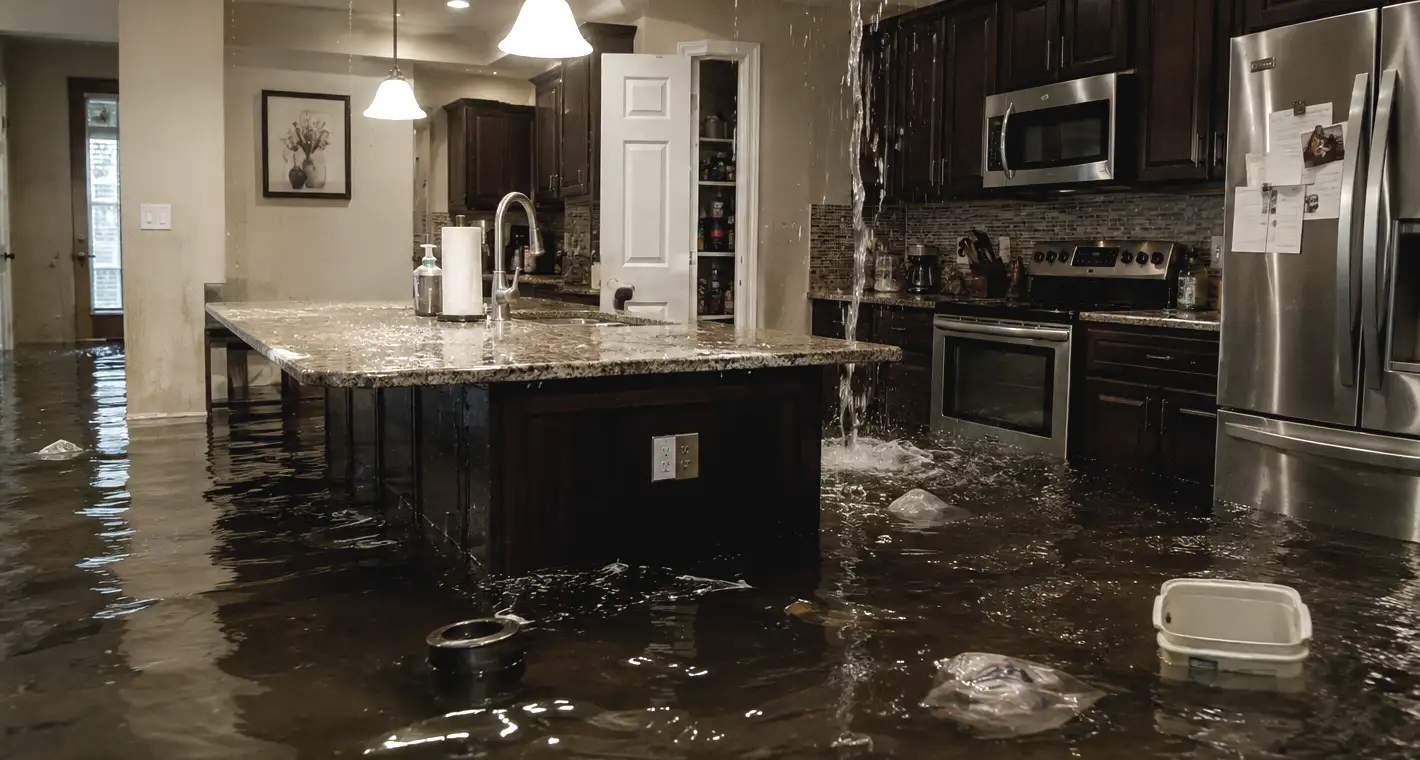
Before entering a flooded basement
- Do not step into standing water if it has reached outlets, cords, the furnace or the panel.
- Shut power to the basement at the panel only if you can reach it without standing in water.
- If the water may be sewage, stay out and keep children and pets away.
- Photograph the water line on the wall before anything is moved.
Where basement water in Utah County comes from
The source determines the response, so identifying it early matters more than it might seem.
Groundwater and a rising water table
In a heavy runoff year, snowmelt off the Wasatch raises the water table across the valley floor. Water enters through cold joints, foundation cracks and the slab perimeter under steady pressure rather than in a single event. Homes near Utah Lake and along the Provo River, Hobble Creek and American Fork Creek see this first.
Window wells and surface drainage
A window well with a blocked or undersized drain fills faster than it clears during a cloudburst or a rapid melt, and then the window is simply below the water level. Landscaping and grading that has settled over several seasons commonly redirects surface water toward the house without anyone noticing.
Sump pump failure
Where the water table is high, the sump pump is a primary defence rather than a backup. Pumps fail from age, from a stuck float, or from losing power in the same storm that is driving the water. Basements that depend on a pump can fill within hours once it stops.
Plumbing and appliance failures
Water heaters, washing machine hoses, water softeners and supply lines are usually installed in the basement or the garage next to it. When one lets go, it empties at the bottom of the house.
Sewer backup
Older laterals in the historic parts of Provo, American Fork, Pleasant Grove and Payson are prone to root intrusion and settled joints. A backup brings contaminated water into finished space and is handled under different rules from clean water.
What the cleanup involves
Standing water is extracted first. Where the water was clean and the response was quick, most of the structure can then be dried in place: framing, subfloor and concrete return to normal moisture under air movers and dehumidification. Carpet padding is normally removed because it holds water and dries too slowly to keep the carpet above it viable.
Drywall is the material homeowners most often expect to save and most often cannot. It wicks water upward well past the visible line, so it is typically cut back above the mark rather than dried. Wet insulation behind it is removed, since saturated insulation loses its function and holds water against the framing.
Where groundwater is the source, the intrusion has to be established as finished before a drying plan makes sense. Drying a basement that is still taking on water accomplishes very little, and moisture in the slab itself is measured separately from moisture in the finish materials above it.
Basement flood cleanup by city
- ProvoZIP 84601, 84604, 84606
- OremZIP 84057, 84058, 84097
- LehiZIP 84043
- Eagle MountainZIP 84005
- Saratoga SpringsZIP 84045
- Spanish ForkZIP 84660
- Pleasant GroveZIP 84062
- SpringvilleZIP 84663
- American ForkZIP 84003
- PaysonZIP 84651
Frequently Asked Questions
- Water came up through the floor instead of in from a pipe. What does that mean?
- It points to groundwater rather than a plumbing failure. In a wet spring the water table can rise to where hydrostatic pressure pushes water through cold joints, cracks and around the slab perimeter. That matters because the source is outside the building and may continue, so extraction alone will not settle it if water keeps arriving.
- My sump pump failed. Is that covered by insurance?
- Sump pump failure and the backup that follows are frequently excluded from a standard policy and covered instead by a separate endorsement that has to be purchased in advance. This varies between insurers, so it is worth checking your declarations page rather than assuming either way. Document the water line on the wall before anything is removed.
- The basement is finished. Does everything have to come out?
- Not necessarily, but finished basements lose more than unfinished ones because the materials are absorbent. Carpet padding is normally removed. Drywall is typically cut back above the water line where it has wicked upward, since drywall draws water vertically well beyond the visible mark. Framing, subfloor and concrete are usually dried in place if the water was clean and the response was quick.
- Why do finished basements in Utah get hit so hard?
- Because the bottom floor of the house is living space. Most homes in Utah County have finished basements with bedrooms, carpet and drywall below grade. Water that would be a minor event in an unfinished cellar reaches absorbent finish materials immediately, and there is no unfinished buffer to contain it.
- Can I wait until the weekend to deal with it?
- Waiting works against you. Water continues moving into materials for as long as it sits, so the area affected grows and the proportion that must be removed rather than dried rises. Past roughly the first day or two, absorbed water in drywall and framing creates the conditions where microbial growth becomes a separate problem in addition to the original loss.