
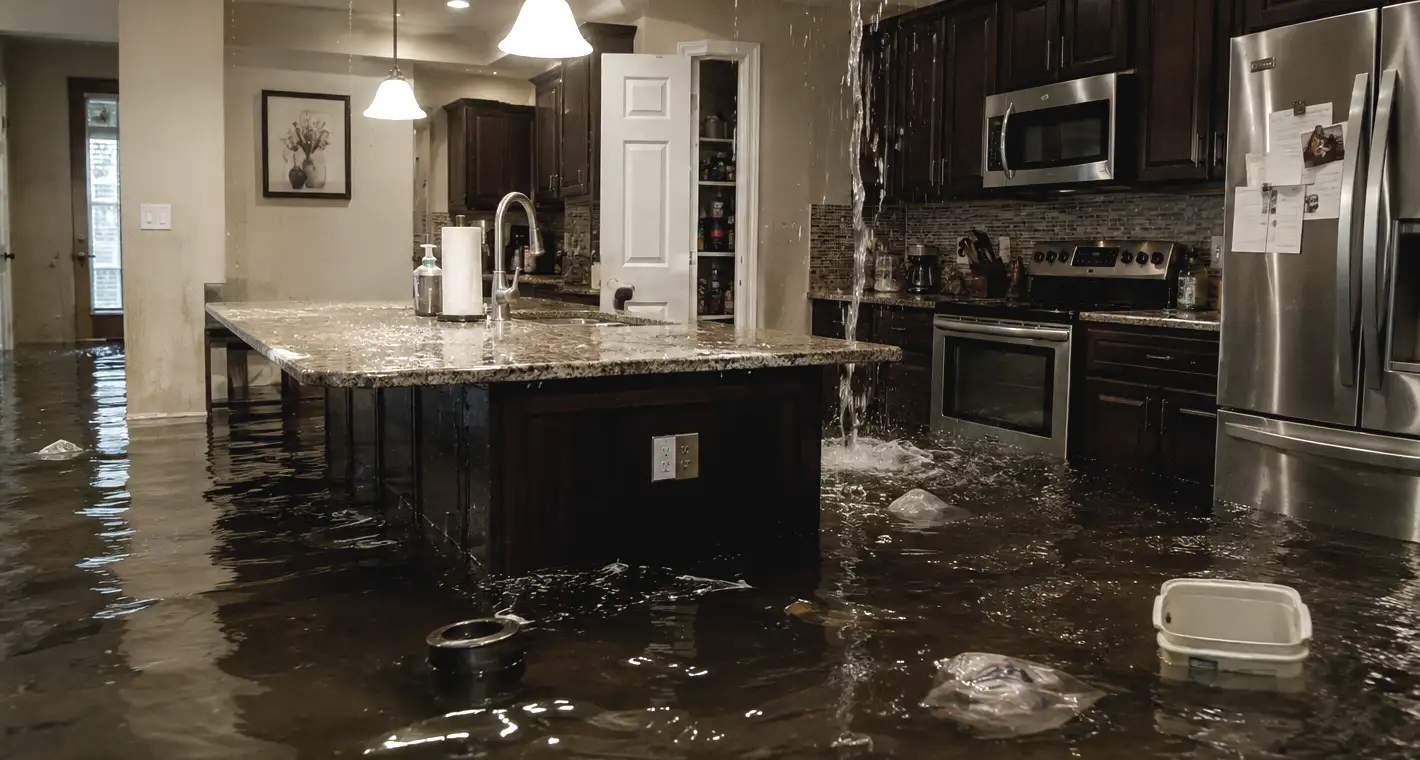
Water damage in Orem
Orem occupies the bench between the Provo River and American Fork, with the mouth of Provo Canyon at its eastern edge and the flats toward Geneva Road to the west. Much of the city was built out between the 1950s and the 1980s, so ranch and split-level homes dominate, with newer infill construction filling in older orchard parcels.
Those two facts shape most of the water losses that happen here. Where a house sits, how old it is, and what its plumbing and drainage were designed for determine both how water gets in and where it travels once it does. Water follows gravity and capillary action rather than room boundaries, so a failure on an upper floor of a Orem home routinely damages rooms that are nowhere near it.
Before help arrives
- Shut the water off at the fixture or the main if you can reach it safely.
- Keep out of any room where water has reached outlets, cords, or the electrical panel.
- Lift furniture off wet carpet and move what you can to a dry floor.
- Photograph the damage and the failure point before anything is moved.
- Do not use a household vacuum to pick up standing water.
Common causes in Orem
Pressurized secondary irrigation
Large parts of Orem run on pressurized secondary irrigation for landscaping. These lines are charged through the warm months and are not always drained properly before the first hard freeze. A cracked line or a failed valve near the house can push a substantial volume of water toward the foundation before anyone notices, because the water is not metered the way culinary water is.
Water heaters at the end of their service life
A great many Orem homes still have water heaters installed during a single wave of renovations. Utah water is hard, and scale shortens tank life. When the tank finally goes, it usually goes in a basement or a garage adjoining living space, and it empties completely.
Wind-driven rain out of Provo Canyon
The canyon mouth funnels wind across the eastern neighborhoods. Rain driven sideways finds its way past window flashing and under shingle courses in a way that ordinary rainfall does not, so leaks appear during storms and then seem to stop.
Aging supply lines to appliances
Braided and rubber washing machine hoses harden over time. A hose that lets go on the main floor sends water down through the ceiling into the basement, damaging two levels at once.
Drying a Orem home
Most Orem homes are 1950s to 1980s ranch and split-level, which means original subfloor and, in many houses, carpet laid straight onto concrete in the lower level. Water tracks under that carpet without showing at the surface, so the padding is normally pulled to see what is underneath.
The sequence itself does not change from house to house: extraction first, then air movers and dehumidifiers working together, with moisture readings logged each day until the affected materials match the dry baseline for that building. It is described in full on the water extraction and drying page.
Services available in Orem
- Water Extraction & DryingStanding water removed, structure dried under moisture readings.
- Basement Flood CleanupGroundwater, sump failure, window wells and plumbing losses.
- Sewage CleanupContaminated water, handled with containment and removal.
- Mold RemediationGrowth that followed water left in the structure too long.
- Burst pipe and supply line cleanup
- Water heater and appliance leak cleanup
- Ceiling and drywall water damage
- Moisture inspection and mapping
Areas covered in Orem
Providers cover Orem and the surrounding area, including Sharon Park, Cascade, Northridge, Suncrest, Lakeridge, Windsor, Hillcrest, Geneva Heights, Cherry Hill and Orem Heights.
ZIP codes: 84057, 84058, 84097.
Frequently Asked Questions
- Will my homeowners insurance cover water damage?
- It depends on the cause rather than the damage. Policies commonly cover sudden and accidental events such as a burst supply line, a failed water heater, or an appliance hose that lets go. Damage that developed gradually from a long-standing leak, and damage from surface flooding, are typically handled differently or excluded. Photograph everything before anything is moved or removed, keep any failed part, and report the loss to your insurer promptly, because most policies require you to take reasonable steps to prevent further damage.
- Should I turn off the electricity?
- If water has reached outlets, cords, appliances, or the panel itself, treat the area as unsafe. Only shut off the breaker if you can reach the panel without standing in water and without touching anything wet. If you cannot reach it safely, leave the area and have the utility or an electrician handle it. No amount of property is worth a shock hazard.
- My water heater is original to the house. What are the signs it is close to failing?
- Rust-coloured water at the hot tap, a rumbling sound when it heats, damp or corrosion around the base, and age past ten to twelve years. Utah water is hard, and the scale that builds inside the tank both shortens its life and hides thinning until the shell lets go. Most tanks fail by opening rather than dripping, so the whole contents end up on the floor.
- Wind from Provo Canyon drives rain under my shingles. Is that water damage?
- It is, though it behaves differently from a plumbing failure. Wind-driven rain gets past flashing and under shingle courses in a way ordinary rainfall does not, so leaks appear only when wind and rain arrive together and seem to stop in between. The cavity behind the wall stays wet the whole time, which is why the drying step matters even after the roof is repaired.
- My split-level has water between the levels. Where does it collect?
- At the intermediate landing and in the wall cavity beside the stairs, which is where the framing changes direction and gives water somewhere to sit. Split-level layouts also put the lower floor partly below grade, so anything that gets past the landing ends up there. Those two places are checked with a meter even when nothing is visible on the surface.
- Secondary irrigation flooded my yard and it reached the house. Is that treated differently?
- The cleanup itself is similar, but the water source matters for classification. Irrigation water is not treated to culinary standards and may carry soil and organic material, so materials it soaks are usually handled more conservatively than a clean supply line break. Mention the source when you call, because it changes what can be dried in place and what should be removed.