
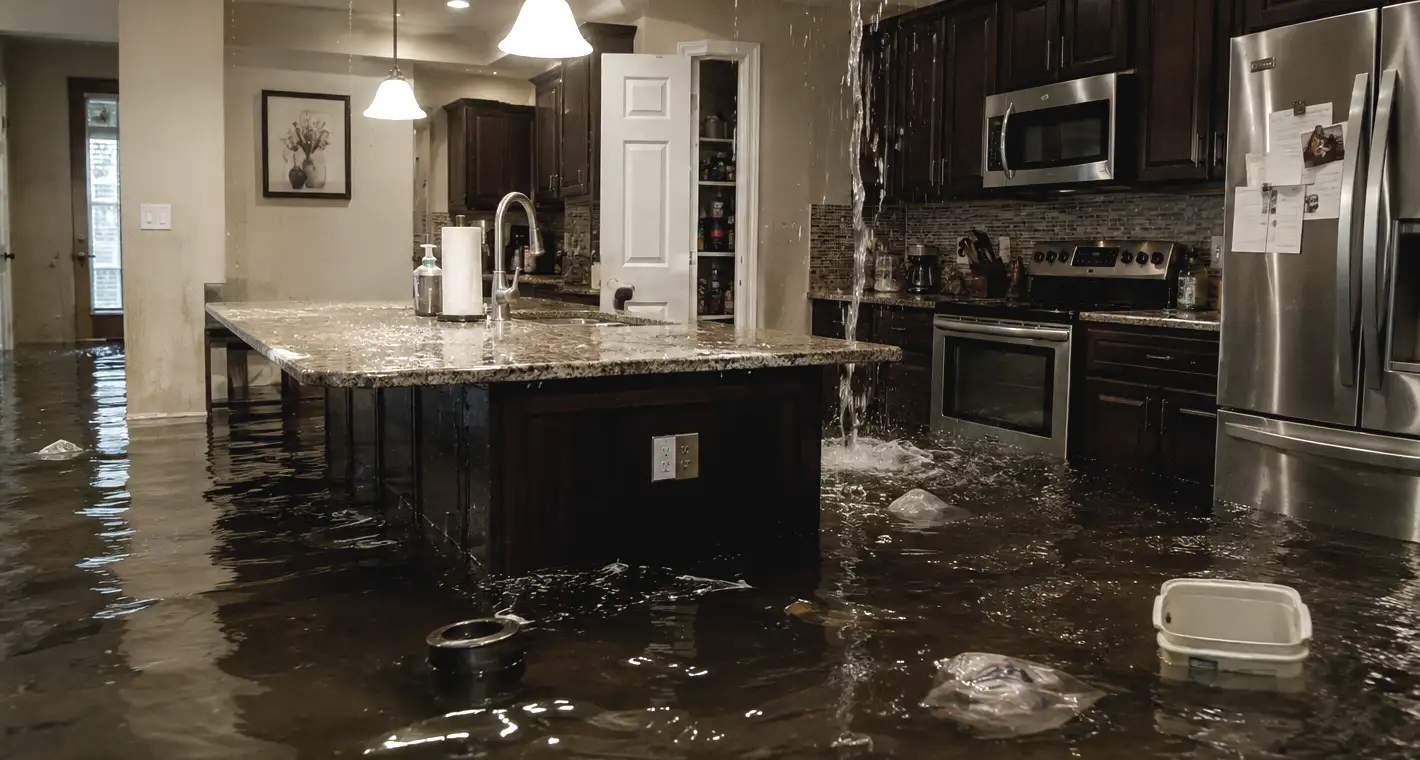
Water damage in Lehi
Lehi spreads from the Jordan River on the west up to Traverse Mountain on the north, with the Silicon Slopes corridor running through the middle of the city. Lehi has grown faster than almost anywhere in the county. Most of its housing stock went up after 2000, though a historic core remains near Main Street and State Street.
Those two facts shape most of the water losses that happen here. Where a house sits, how old it is, and what its plumbing and drainage were designed for determine both how water gets in and where it travels once it does. Water follows gravity and capillary action rather than room boundaries, so a failure on an upper floor of a Lehi home routinely damages rooms that are nowhere near it.
Before help arrives
- Shut the water off at the fixture or the main if you can reach it safely.
- Keep out of any room where water has reached outlets, cords, or the electrical panel.
- Lift furniture off wet carpet and move what you can to a dry floor.
- Photograph the damage and the failure point before anything is moved.
- Do not use a household vacuum to pick up standing water.
Common causes in Lehi
Plumbing failures in newer construction
New does not mean immune. Rapid building schedules produce crimped PEX fittings, over-torqued connections, and supply lines that were nicked during framing. These failures tend to appear in the first several years rather than after decades, and they often occur upstairs where the damage travels down through two floors.
Finished basements built to the lot line
High-density lots in Lehi mean deep, fully finished basements with bedrooms and living space below grade. When water enters at that level it reaches finished materials immediately, and there is no unfinished buffer space to contain it.
Jordan River floodplain on the west side
Properties nearer the river sit on ground with a shallower water table. During a heavy runoff year, hydrostatic pressure against foundation walls increases and older window well drains can back up.
Freeze exposure on Traverse Mountain
Homes higher on the bench sit colder and windier than the valley floor. Pipes running through exterior walls or unconditioned garage spaces are more likely to freeze there during a cold snap.
Drying a Lehi home
Lehi housing is mostly post-2000, which usually means modern drywall, engineered subfloor and deep finished basements. Engineered flooring is the material that most often cannot be saved: it swells at the seams once water gets under it, and the swelling does not reverse when the moisture leaves.
The sequence itself does not change from house to house: extraction first, then air movers and dehumidifiers working together, with moisture readings logged each day until the affected materials match the dry baseline for that building. It is described in full on the water extraction and drying page.
Services available in Lehi
- Water Extraction & DryingStanding water removed, structure dried under moisture readings.
- Basement Flood CleanupGroundwater, sump failure, window wells and plumbing losses.
- Sewage CleanupContaminated water, handled with containment and removal.
- Mold RemediationGrowth that followed water left in the structure too long.
- Burst pipe and supply line cleanup
- Water heater and appliance leak cleanup
- Ceiling and drywall water damage
- Moisture inspection and mapping
Areas covered in Lehi
Providers cover Lehi and the surrounding area, including Traverse Mountain, Thanksgiving Point, Holbrook Farms, Spring Creek, Historic Lehi, Ivory Ridge and Sandalwood.
ZIP codes: 84043.
Frequently Asked Questions
- Will my homeowners insurance cover water damage?
- It depends on the cause rather than the damage. Policies commonly cover sudden and accidental events such as a burst supply line, a failed water heater, or an appliance hose that lets go. Damage that developed gradually from a long-standing leak, and damage from surface flooding, are typically handled differently or excluded. Photograph everything before anything is moved or removed, keep any failed part, and report the loss to your insurer promptly, because most policies require you to take reasonable steps to prevent further damage.
- Should I turn off the electricity?
- If water has reached outlets, cords, appliances, or the panel itself, treat the area as unsafe. Only shut off the breaker if you can reach the panel without standing in water and without touching anything wet. If you cannot reach it safely, leave the area and have the utility or an electrician handle it. No amount of property is worth a shock hazard.
- What tends to fail first in a house built in the last ten years?
- Connections rather than pipe. Crimped PEX fittings, supply lines to toilets and sinks, and washing machine hoses account for most of it. These fail early rather than after decades, and they usually let go on an upper floor where the damage travels down through two levels before anyone notices.
- My basement bedroom is below grade. What happens there in a wet spring?
- On the west side of Lehi, closer to the Jordan River, the water table sits higher and pushes against the foundation continuously rather than in a single event. Below-grade bedrooms have carpet, padding and drywall at the bottom of the house, so intrusion reaches absorbent material immediately. A window well with a blocked drain turns a wet week into standing water.
- Traverse Mountain runs colder than the valley. Does that change freeze risk?
- It does. Higher on the bench the overnight lows are lower and the wind exposure is greater, so plumbing routed through exterior walls, unheated garages and attic spaces freezes at valley temperatures that would be safe further down. The failure usually shows when the ice thaws rather than when it forms.
- My house is only a few years old. Could this still be covered by the builder?
- It may be. Many builders provide a limited warranty covering plumbing and workmanship for a defined period, and some component manufacturers warrant their fittings separately. That is a separate question from cleanup, which usually cannot wait. Document the failure point with photographs before anything is removed, and keep the failed part if a technician takes it out.