
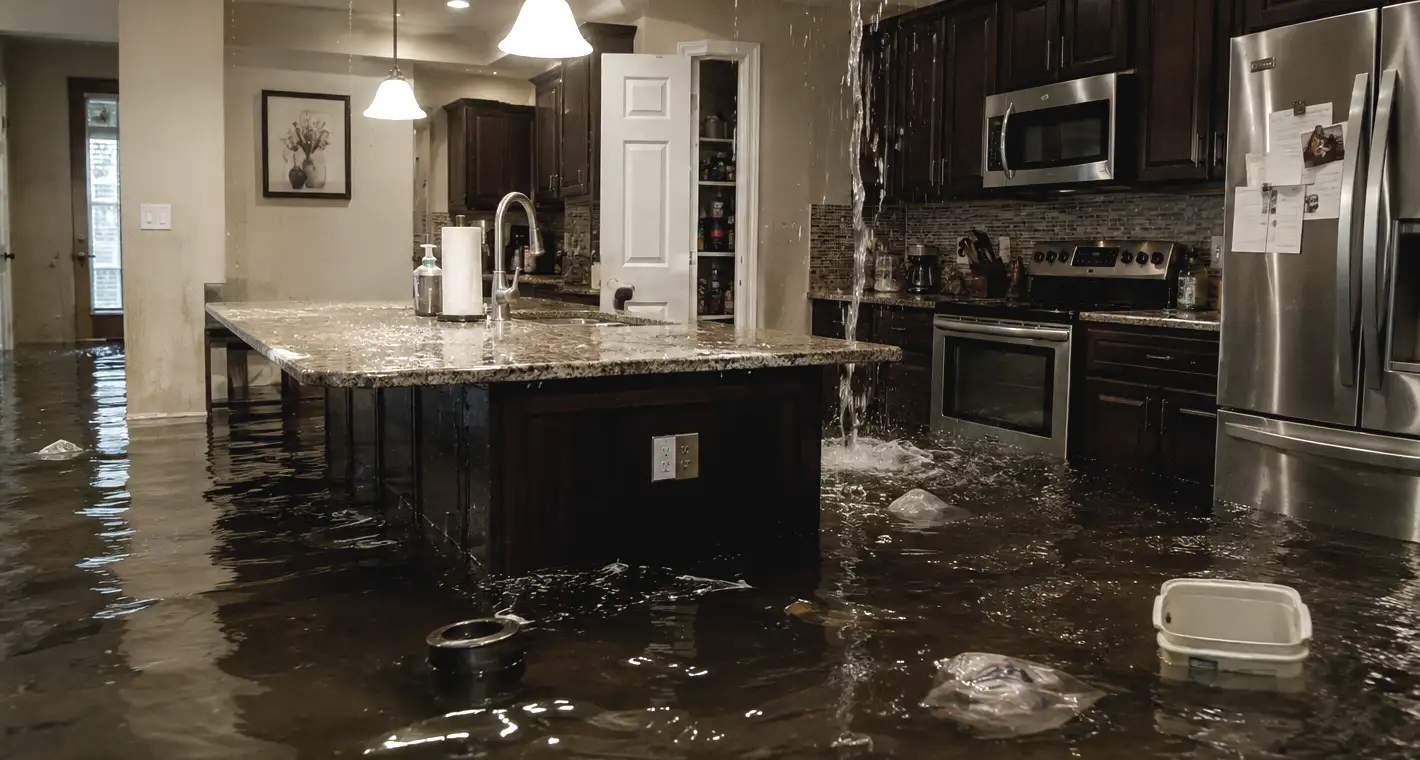
Water damage in Eagle Mountain
Eagle Mountain sits in Cedar Valley on the far side of the Lake Mountains, west of Utah Lake, in higher and drier country than the rest of the county. The city is almost entirely post-2000 construction, laid out in large subdivisions on generous lots with long runs between the street and the house.
Those two facts shape most of the water losses that happen here. Where a house sits, how old it is, and what its plumbing and drainage were designed for determine both how water gets in and where it travels once it does. Water follows gravity and capillary action rather than room boundaries, so a failure on an upper floor of a Eagle Mountain home routinely damages rooms that are nowhere near it.
Before help arrives
- Shut the water off at the fixture or the main if you can reach it safely.
- Keep out of any room where water has reached outlets, cords, or the electrical panel.
- Lift furniture off wet carpet and move what you can to a dry floor.
- Photograph the damage and the failure point before anything is moved.
- Do not use a household vacuum to pick up standing water.
Common causes in Eagle Mountain
Long service lines and exposed exterior runs
Large lots mean long water service lines from the street to the house, and in some layouts the line runs shallower than ideal. Cedar Valley also runs colder at night than the Provo side of the Lake Mountains, so freeze events reach further into plumbing that would be safe elsewhere in the county.
Sprinkler and backflow assembly failures
Backflow preventers sit above ground and are the first thing to freeze if they are not blown out and insulated before winter. A split assembly next to the foundation can run continuously once the system is charged again in the spring.
Construction-era defects
Whole neighborhoods here were built in a compressed window by the same crews. When a particular fitting or connector turns out to be faulty, it tends to fail across many houses in the same few years rather than in isolation.
Unfinished basements that became finished later
Many homes were sold with unfinished basements that owners completed afterward. Finish work done without a permit sometimes covers over the floor drain or the sump location, which removes the escape path water was supposed to take.
Drying a Eagle Mountain home
Eagle Mountain homes are almost all post-2000 with large unfinished or owner-finished basements. Owner-finished space is worth flagging when you call: framing and flooring added later often sit directly on slab without the vapour barrier a builder would have used, and that changes how long the concrete takes to release moisture.
The sequence itself does not change from house to house: extraction first, then air movers and dehumidifiers working together, with moisture readings logged each day until the affected materials match the dry baseline for that building. It is described in full on the water extraction and drying page.
Services available in Eagle Mountain
- Water Extraction & DryingStanding water removed, structure dried under moisture readings.
- Basement Flood CleanupGroundwater, sump failure, window wells and plumbing losses.
- Sewage CleanupContaminated water, handled with containment and removal.
- Mold RemediationGrowth that followed water left in the structure too long.
- Burst pipe and supply line cleanup
- Water heater and appliance leak cleanup
- Ceiling and drywall water damage
- Moisture inspection and mapping
Areas covered in Eagle Mountain
Providers cover Eagle Mountain and the surrounding area, including The Ranches, City Center, SilverLake, Overland, Hidden Hollow, Kiowa Valley and Sunset Flats.
ZIP codes: 84005.
Frequently Asked Questions
- Will my homeowners insurance cover water damage?
- It depends on the cause rather than the damage. Policies commonly cover sudden and accidental events such as a burst supply line, a failed water heater, or an appliance hose that lets go. Damage that developed gradually from a long-standing leak, and damage from surface flooding, are typically handled differently or excluded. Photograph everything before anything is moved or removed, keep any failed part, and report the loss to your insurer promptly, because most policies require you to take reasonable steps to prevent further damage.
- Should I turn off the electricity?
- If water has reached outlets, cords, appliances, or the panel itself, treat the area as unsafe. Only shut off the breaker if you can reach the panel without standing in water and without touching anything wet. If you cannot reach it safely, leave the area and have the utility or an electrician handle it. No amount of property is worth a shock hazard.
- My backflow preventer split over the winter. How much water can that put out?
- A great deal, because it is on the pressurised side and nothing meters it. Backflow assemblies sit above ground next to the foundation and are the first component to freeze if they are not drained and insulated. When the system is charged again in spring, a split assembly can run continuously until someone notices the wet ground, which is often days.
- Whole streets here went up at once. Does that mean neighbours get the same failure?
- Often yes. Subdivisions built in a compressed window by the same crews share the same fittings, the same connectors and the same installation habits. When a particular component turns out to be faulty, it tends to fail across many houses within the same couple of years rather than at random. It is worth asking neighbours whether they have had anything similar.
- I finished the basement myself. Could that have covered the floor drain?
- It happens frequently. Finish work done without a permit sometimes frames over or tiles across the floor drain and the sump location, which removes the escape route water was meant to take. If you know roughly where the drain was, say so when you call, because opening that spot early can stop water spreading further into finished rooms.
- Is response time longer out here than in Provo or Orem?
- It can be. Cedar Valley is separated from the rest of Utah County by the Lake Mountains, and providers coming from the Provo side travel around through Lehi or over the pass. When you call, say that the property is in Eagle Mountain rather than just Utah County, so arrival time is estimated realistically rather than optimistically.