
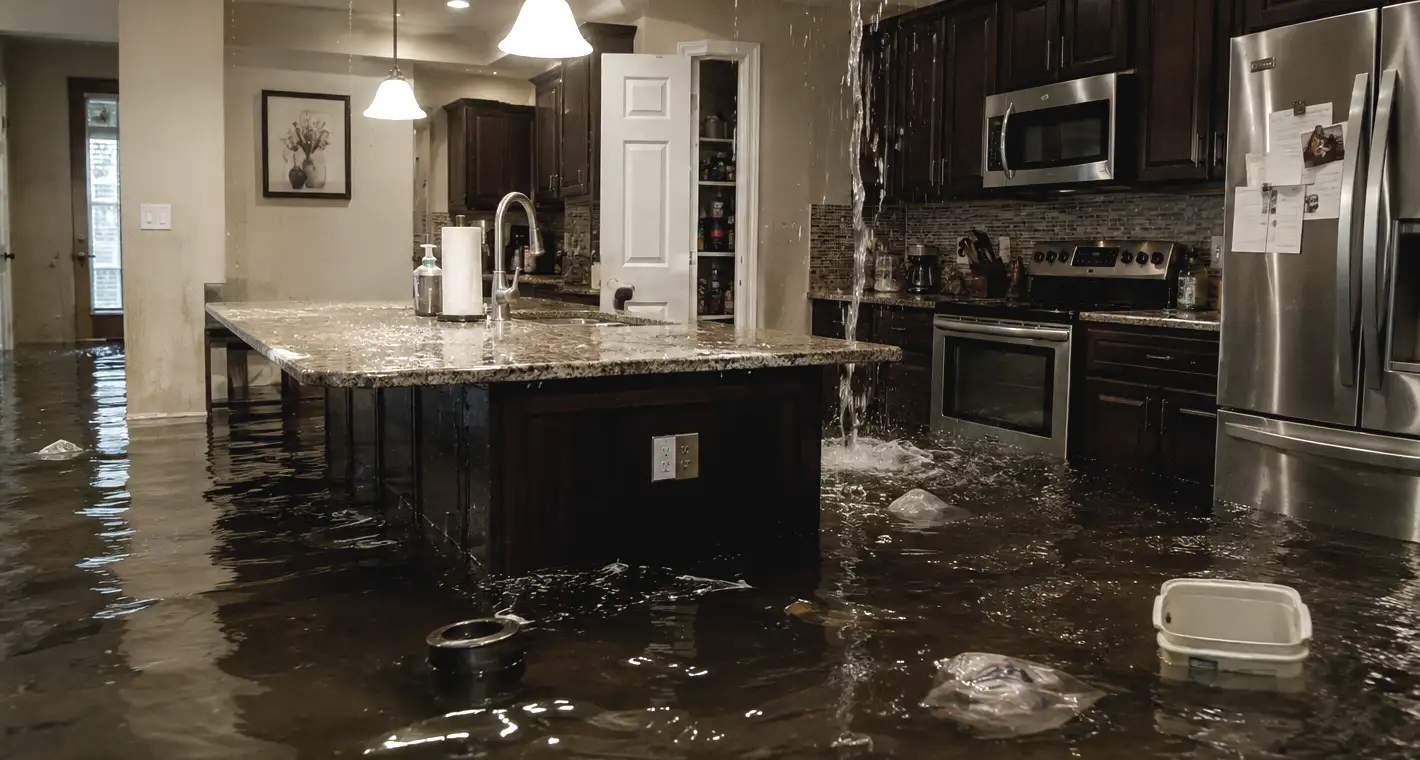
Water damage in Saratoga Springs
Saratoga Springs runs along the western shore of Utah Lake, from the Jordan River outlet in the north down the shoreline toward the Lake Mountains. Nearly all of the housing is recent, and a large share of it is built into slope with walkout or daylight basements facing the lake.
Those two facts shape most of the water losses that happen here. Where a house sits, how old it is, and what its plumbing and drainage were designed for determine both how water gets in and where it travels once it does. Water follows gravity and capillary action rather than room boundaries, so a failure on an upper floor of a Saratoga Springs home routinely damages rooms that are nowhere near it.
Before help arrives
- Shut the water off at the fixture or the main if you can reach it safely.
- Keep out of any room where water has reached outlets, cords, or the electrical panel.
- Lift furniture off wet carpet and move what you can to a dry floor.
- Photograph the damage and the failure point before anything is moved.
- Do not use a household vacuum to pick up standing water.
Common causes in Saratoga Springs
A shallow water table near the shoreline
Properties closest to Utah Lake sit on ground where groundwater is not far below the basement slab. Lake levels move year to year, and in a high-water year hydrostatic pressure pushes against foundation walls and slabs continuously rather than during a single storm.
Dependence on sump pumps
Where the water table is high, the sump pump is not a backup device, it is a primary one. A pump that fails during a wet spring, or that loses power in a storm, allows water to rise into finished basement space within hours. Pumps installed with the house are now reaching the age where failures begin.
Walkout basement door and window thresholds
Walkout designs put a full door at the bottom of the house. Grading that has settled over a few seasons can direct surface water straight at that threshold during heavy rain or rapid melt.
New-build plumbing failures
As with the rest of the fast-growing west side of the county, supply line and fitting failures in newer homes are a common source of interior water damage.
Drying a Saratoga Springs home
Many Saratoga Springs homes are built into slope with walkout or daylight basements facing Utah Lake. Where the water table is close to the slab, the concrete itself holds moisture and releases it slowly, so slab readings are logged separately from the finish materials above and usually take longer to come down.
The sequence itself does not change from house to house: extraction first, then air movers and dehumidifiers working together, with moisture readings logged each day until the affected materials match the dry baseline for that building. It is described in full on the water extraction and drying page.
Services available in Saratoga Springs
- Water Extraction & DryingStanding water removed, structure dried under moisture readings.
- Basement Flood CleanupGroundwater, sump failure, window wells and plumbing losses.
- Sewage CleanupContaminated water, handled with containment and removal.
- Mold RemediationGrowth that followed water left in the structure too long.
- Burst pipe and supply line cleanup
- Water heater and appliance leak cleanup
- Ceiling and drywall water damage
- Moisture inspection and mapping
Areas covered in Saratoga Springs
Providers cover Saratoga Springs and the surrounding area, including Harvest Hills, Jacobs Ranch, Israel Canyon, Wander, Talus Ridge, Lake Mountain Estates and Pelican Bay.
ZIP codes: 84045.
Frequently Asked Questions
- Will my homeowners insurance cover water damage?
- It depends on the cause rather than the damage. Policies commonly cover sudden and accidental events such as a burst supply line, a failed water heater, or an appliance hose that lets go. Damage that developed gradually from a long-standing leak, and damage from surface flooding, are typically handled differently or excluded. Photograph everything before anything is moved or removed, keep any failed part, and report the loss to your insurer promptly, because most policies require you to take reasonable steps to prevent further damage.
- Should I turn off the electricity?
- If water has reached outlets, cords, appliances, or the panel itself, treat the area as unsafe. Only shut off the breaker if you can reach the panel without standing in water and without touching anything wet. If you cannot reach it safely, leave the area and have the utility or an electrician handle it. No amount of property is worth a shock hazard.
- How do I tell whether my sump pump is close to failing?
- Pour a bucket of water into the pit and watch it cycle. It should start promptly, discharge steadily and shut off cleanly. Warning signs are a float that sticks, a pump that runs but moves little water, rattling on start-up, and age past about seven years. Where the water table is high the pump is a primary defence rather than a backup, so a spare and a battery backup are worth having.
- My walkout door sits at the bottom of the lot. What can I do before the next storm?
- Check that the ground still falls away from the threshold; grading settles over a few seasons and quietly reverses. Clear the drain in front of the door and confirm it actually runs. Downspouts should discharge well past the walkout rather than beside it. None of that helps once water is against the door, so it is worth doing while things are dry.
- Utah Lake is high this year. Does that reach my basement?
- Indirectly, and it is the most common cause of basement moisture on this side of the valley. The lake level and the shallow groundwater behind it move together, so in a high year the water table sits closer to basement slabs along the shoreline. Nothing inside the house has to fail for a basement to take on water in those conditions.
- Water came up through the basement floor rather than in from a pipe. Can that be dried?
- Often yes, but the approach differs. Groundwater intrusion means the source is outside the building and may continue, so extraction and drying alone will not settle the problem if the water keeps arriving. A technician will normally want to establish whether the intrusion has stopped before committing to a drying plan, and the moisture in the slab itself is measured separately from the moisture in the finish materials above it.