
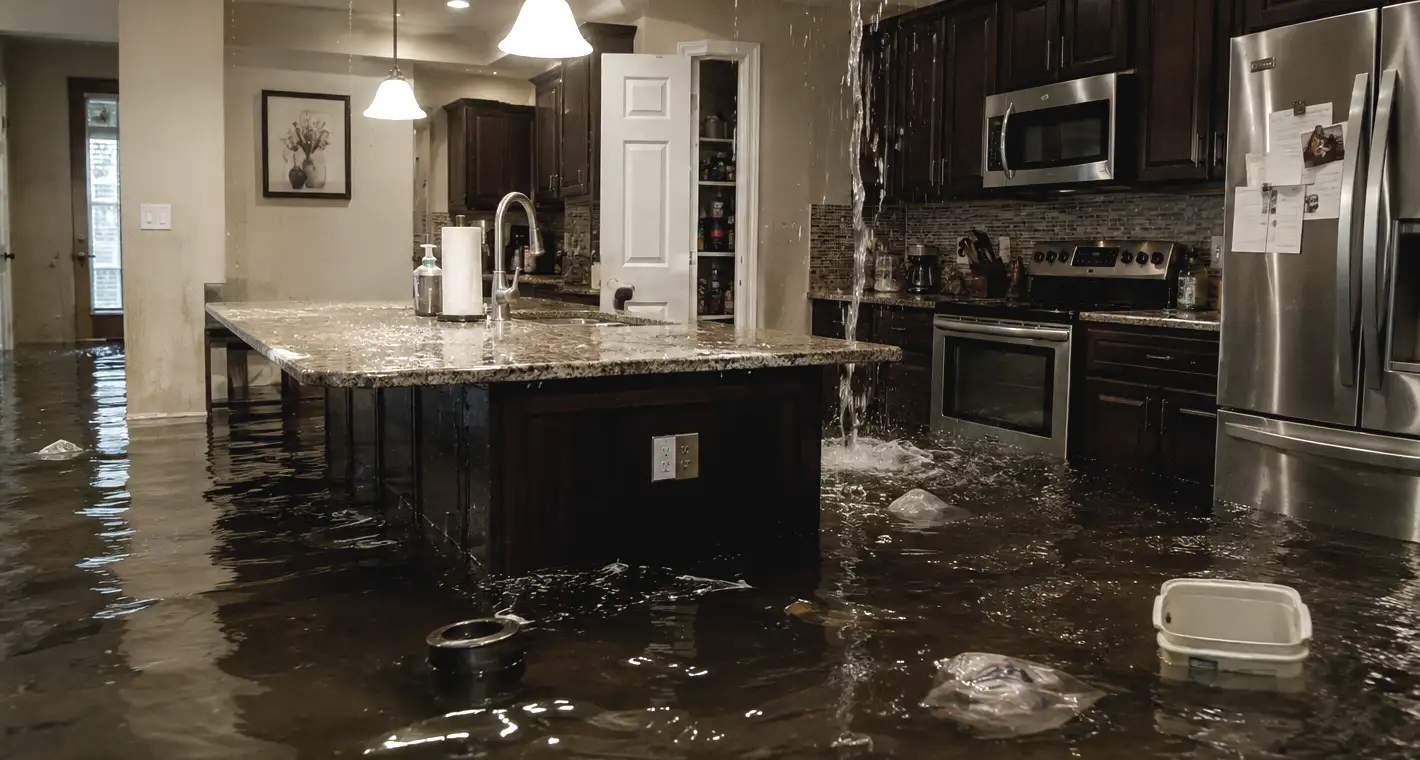
Water damage in American Fork
American Fork sits at the north end of Utah County below the mouth of American Fork Canyon, with American Fork Creek running down through the city toward the lake. A historic downtown grid is surrounded by mid-century neighborhoods, with newer construction filling the north bench toward Highland and Cedar Hills.
Those two facts shape most of the water losses that happen here. Where a house sits, how old it is, and what its plumbing and drainage were designed for determine both how water gets in and where it travels once it does. Water follows gravity and capillary action rather than room boundaries, so a failure on an upper floor of a American Fork home routinely damages rooms that are nowhere near it.
Before help arrives
- Shut the water off at the fixture or the main if you can reach it safely.
- Keep out of any room where water has reached outlets, cords, or the electrical panel.
- Lift furniture off wet carpet and move what you can to a dry floor.
- Photograph the damage and the failure point before anything is moved.
- Do not use a household vacuum to pick up standing water.
Common causes in American Fork
American Fork Canyon runoff
The canyon drains a large, steep catchment. Spring melt and summer cloudbursts both send water down through the city faster than the older storm drainage in the historic grid was designed to handle, and low-lying properties see it first.
Older clay sewer laterals
Much of the downtown grid is served by clay laterals installed decades ago. Root intrusion at the joints is common, and the resulting backups bring contaminated water into finished basement space.
Creek-adjacent properties
Homes near American Fork Creek sit on ground with a shallower water table, and foundation seepage becomes more likely in a heavy runoff year even without any surface flooding.
Freeze on north-facing exposures
The north bench sits higher and colder, and plumbing routed through north-facing exterior walls or unheated garages is the first to freeze during a cold snap.
Drying a American Fork home
American Fork housing splits between the historic downtown grid and newer building on the north bench, and the two dry differently. Downtown houses often have unvented crawl spaces under part of the floor, which hold humid air and slow everything above them until they are dried as well.
The sequence itself does not change from house to house: extraction first, then air movers and dehumidifiers working together, with moisture readings logged each day until the affected materials match the dry baseline for that building. It is described in full on the water extraction and drying page.
Services available in American Fork
- Water Extraction & DryingStanding water removed, structure dried under moisture readings.
- Basement Flood CleanupGroundwater, sump failure, window wells and plumbing losses.
- Sewage CleanupContaminated water, handled with containment and removal.
- Mold RemediationGrowth that followed water left in the structure too long.
- Burst pipe and supply line cleanup
- Water heater and appliance leak cleanup
- Ceiling and drywall water damage
- Moisture inspection and mapping
Areas covered in American Fork
Providers cover American Fork and the surrounding area, including Historic Downtown, Shelley, Forbes, North Bench, Hillcrest, Meadows and Cedar Ridge.
ZIP codes: 84003.
Frequently Asked Questions
- Will my homeowners insurance cover water damage?
- It depends on the cause rather than the damage. Policies commonly cover sudden and accidental events such as a burst supply line, a failed water heater, or an appliance hose that lets go. Damage that developed gradually from a long-standing leak, and damage from surface flooding, are typically handled differently or excluded. Photograph everything before anything is moved or removed, keep any failed part, and report the loss to your insurer promptly, because most policies require you to take reasonable steps to prevent further damage.
- Should I turn off the electricity?
- If water has reached outlets, cords, appliances, or the panel itself, treat the area as unsafe. Only shut off the breaker if you can reach the panel without standing in water and without touching anything wet. If you cannot reach it safely, leave the area and have the utility or an electrician handle it. No amount of property is worth a shock hazard.
- The storm drain on my street backed up in a cloudburst. Is that mine to deal with?
- The drain itself is the city's, but the water that reached your property is yours to clean up and document. The older storm system in the downtown grid was sized before the surrounding area filled in, so it surcharges during summer cloudbursts. Photograph the street and the entry point as well as the interior; that record matters if you pursue the municipality.
- Pipes froze in my garage on the north bench. How do I prevent it next winter?
- Insulate the runs rather than the garage, keep the garage door shut during cold snaps, and where a line runs through an exterior wall on the north side, consider rerouting or adding heat tape. The bench sits higher and colder than the valley floor, so plumbing that has been fine for years can freeze in a hard winter.
- Clay sewer lines are common downtown. What are the early signs of trouble?
- Repeated slow drainage at the fixture nearest the basement floor, gurgling when a large volume discharges, and backing up that resolves on its own and returns weeks later. Root intrusion at settled joints is the usual cause. The distinction matters because a sewer backup brings contaminated water into finished space and is handled under different rules from a clean supply failure.
- How quickly does water damage need to be addressed?
- Sooner is materially better. Water migrates into materials continuously, so the area affected grows for as long as it sits. Beyond roughly the first day or two, absorbed water in drywall, framing, and subfloor creates conditions where microbial growth becomes a separate problem in addition to the original loss. That is why extraction is normally treated as urgent even when the visible water seems manageable.