
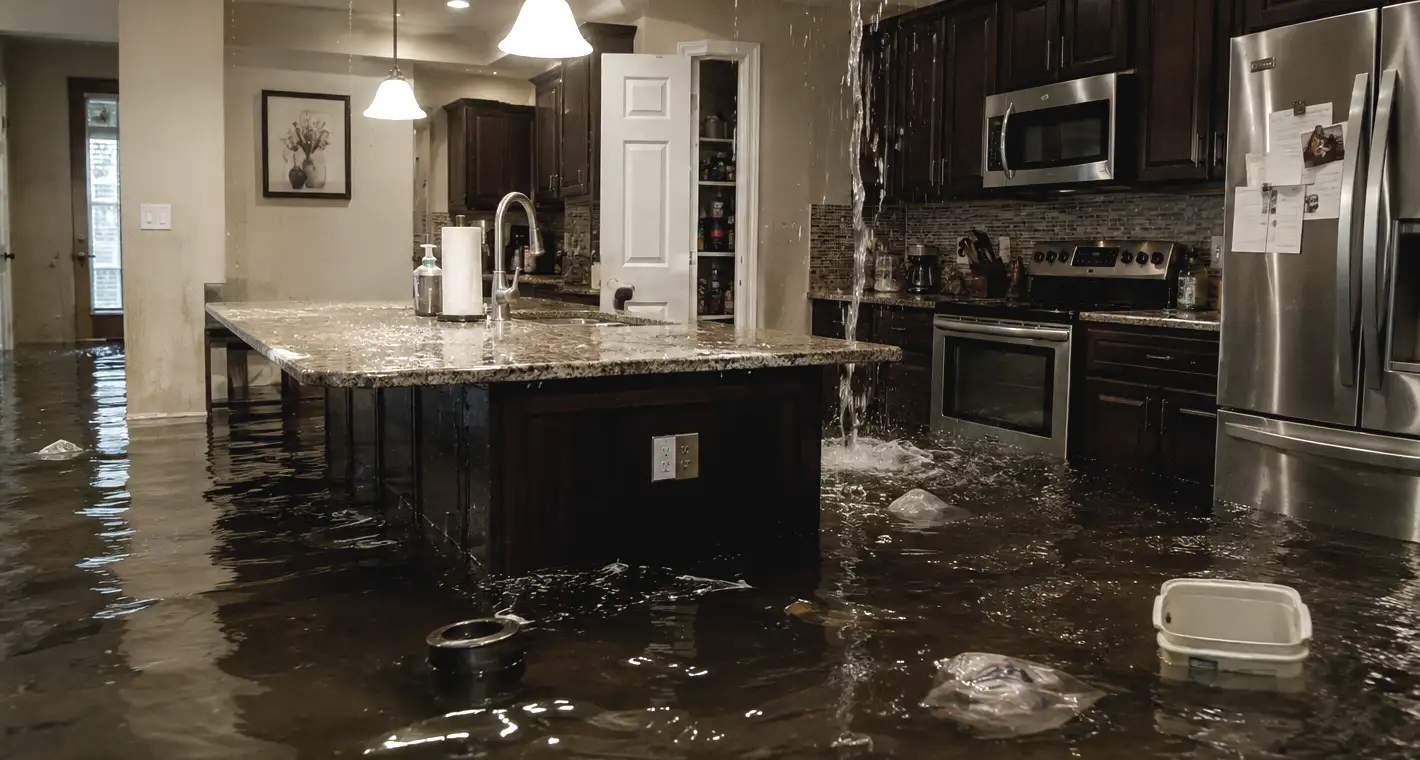
Water damage in Pleasant Grove
Pleasant Grove climbs from the valley floor up toward the mouths of Grove Creek and Battle Creek canyons, with the steep Wasatch face directly above the eastern neighborhoods. The city center holds a good deal of older housing, while the bench above it filled in later with larger homes on steeper ground.
Those two facts shape most of the water losses that happen here. Where a house sits, how old it is, and what its plumbing and drainage were designed for determine both how water gets in and where it travels once it does. Water follows gravity and capillary action rather than room boundaries, so a failure on an upper floor of a Pleasant Grove home routinely damages rooms that are nowhere near it.
Before help arrives
- Shut the water off at the fixture or the main if you can reach it safely.
- Keep out of any room where water has reached outlets, cords, or the electrical panel.
- Lift furniture off wet carpet and move what you can to a dry floor.
- Photograph the damage and the failure point before anything is moved.
- Do not use a household vacuum to pick up standing water.
Common causes in Pleasant Grove
Canyon creek runoff in spring
Grove Creek and Battle Creek both drain steep, fast catchments. When a warm storm falls on late snow, these creeks rise quickly and the drainage crossing the bench neighborhoods carries more than it was sized for. Surface water reaching a window well can fill it faster than the well drain can clear it.
Foothill drainage and grading
Homes built into slope depend on grading and foundation drains to move water around rather than through the structure. Landscaping changes made years after construction commonly interrupt that path without anyone realizing it until a wet spring.
Older sewer laterals
The lines running from older houses in the city center to the main have been in the ground a long time. Root intrusion and settled joints produce backups, and a sewage backup is handled far more cautiously than a clean water loss.
Original supply plumbing
Homes in the older parts of the Grove that have not been repiped may still carry their first-generation supply lines, with the corrosion and thinning that come with age.
Drying a Pleasant Grove home
Older homes in the Grove often have finished basements added over the years, sometimes with panelling over furring strips rather than drywall on studs. Panelling hides water well: it can look sound while the framing behind it is saturated, so a small opening is usually made to read the cavity rather than guessing from the surface.
The sequence itself does not change from house to house: extraction first, then air movers and dehumidifiers working together, with moisture readings logged each day until the affected materials match the dry baseline for that building. It is described in full on the water extraction and drying page.
Services available in Pleasant Grove
- Water Extraction & DryingStanding water removed, structure dried under moisture readings.
- Basement Flood CleanupGroundwater, sump failure, window wells and plumbing losses.
- Sewage CleanupContaminated water, handled with containment and removal.
- Mold RemediationGrowth that followed water left in the structure too long.
- Burst pipe and supply line cleanup
- Water heater and appliance leak cleanup
- Ceiling and drywall water damage
- Moisture inspection and mapping
Areas covered in Pleasant Grove
Providers cover Pleasant Grove and the surrounding area, including Manila, Grove Creek, Battle Creek, Downtown, Big Springs, North Field and Mahogany.
ZIP codes: 84062.
Frequently Asked Questions
- Will my homeowners insurance cover water damage?
- It depends on the cause rather than the damage. Policies commonly cover sudden and accidental events such as a burst supply line, a failed water heater, or an appliance hose that lets go. Damage that developed gradually from a long-standing leak, and damage from surface flooding, are typically handled differently or excluded. Photograph everything before anything is moved or removed, keep any failed part, and report the loss to your insurer promptly, because most policies require you to take reasonable steps to prevent further damage.
- Should I turn off the electricity?
- If water has reached outlets, cords, appliances, or the panel itself, treat the area as unsafe. Only shut off the breaker if you can reach the panel without standing in water and without touching anything wet. If you cannot reach it safely, leave the area and have the utility or an electrician handle it. No amount of property is worth a shock hazard.
- Spring runoff from Grove Creek filled my window well. What should I check first?
- Whether the well drain is clear and actually connected. Many wells on the bench have a gravel-filled drain that silts up over years, so the well fills faster than it empties during a fast melt. After that, check the grade above the well: water arriving across the surface is the volume that overwhelms it, and diverting that is more effective than enlarging the drain.
- I regraded the yard two years ago and now the basement is damp. Could that be it?
- Very possibly. Homes built into the foothill slope rely on grading and foundation drains to move water around the structure rather than through it. Landscaping changes made years after construction routinely interrupt that path, and the effect shows up only in a wet spring, which makes the connection easy to miss.
- How do I know if my sewer lateral has roots before it backs up?
- Slow drains that clear and then slow again, gurgling from a floor drain when the washing machine empties, and repeated blockages in the same fixture are the usual early signals. In the older parts of the Grove the laterals are clay and the joints have been in the ground for decades. A camera inspection settles it, and it is considerably cheaper than a backup into finished space.
- Is a sewer backup handled the same way as a burst pipe?
- No, and the difference matters. Water from a sewer backup is treated as contaminated regardless of how it looks. Porous materials it has touched, including carpet, padding, and the lower portion of drywall, are generally removed rather than dried in place, and the area is cleaned and treated before any rebuilding. Tell the person who answers that it is a sewage backup so the right equipment and protective gear are dispatched.